
The outdoor spaces of Vibhajan Vibhishika Smriti Nyas campus are as rich in meaning and significance as its indoor facilities. Spanning several acres of thoughtfully designed memorial gardens, heritage walkways, sculptural installations, and natural landscapes, the campus grounds provide a setting for contemplation, commemoration, and connection that complements the more formal educational and cultural spaces within the buildings.
The master plan of the outdoor spaces was developed by a distinguished team of landscape architects, memorial designers, historians, and community representatives, all of whom worked together over several years to create an environment that honours the past while nurturing the present. The result is a landscape of profound beauty and deep symbolic resonance.
Every element of the outdoor landscape has been chosen with purpose. The species of trees, the orientation of pathways, the placement of sculptural works, the direction of water features — each reflects careful thought about how the designed environment can support visitors in their engagement with a history that is both deeply painful and profoundly important.
At the geographical and spiritual heart of the campus stands the Partition Memorial Monument — the most significant single structure in the entire complex. The Monument is a soaring architectural installation of white marble and red sandstone that draws visual inspiration from both the classical memorial traditions of India and the abstract symbolic language of contemporary commemorative architecture.
The structure rises to a height of 30 metres, visible from across the campus and serving as a visual anchor that orients visitors to the heart of the memorial grounds. Its clean geometric form — a tapering quadrilateral spire — is deliberately restrained, allowing the weight of the inscribed texts to carry the full emotional burden of the monument rather than architectural decoration or ornamentation.
The four faces of the Monument are inscribed with texts drawn from the testimonies of Partition survivors — in Hindi, Urdu, Punjabi, and Bengali — representing the four major linguistic communities most directly affected by the Partition. The texts were selected by a panel of historians, literary scholars, and community representatives, and represent the full range of the survivor experience: fear and flight, loss and grief, resilience and hope.
At the base of the Monument, a sunken circular reflection pool creates a mirror image of the structure, symbolising the doubled grief of two nations separated by a common history. The pool is edged with a low parapet inscribed with the names of the partition-affected districts and provinces, creating a geographic frame for the monument’s testimony.
The Monument is illuminated after dark by a carefully designed lighting scheme that traces the contours of the inscribed texts, making them legible and emotionally present even at night. The effect — of golden words glowing against white marble in the darkness — has been described by visitors as one of the most powerful memorial experiences they have encountered.
Adjacent to the Monument, the Eternal Flame of Remembrance burns continuously as a symbol of the unbroken memory of those who suffered and died during the Partition. The flame was lit on the inaugural Vibhajan Vibhishika Smriti Diwas by the honourable Prime Minister of India and has burned without interruption since that moment.
The Flame is housed in a low bronze brazier set on a plinth of polished black granite, surrounded by a circular forecourt paved with stones contributed by communities from across the affected regions of India, Pakistan, and Bangladesh. This ‘Congress of Stones’ — as it has come to be called by the campus’s guides — is a quiet but powerful symbol of the shared geography that was fractured by Partition.
Citizens, dignitaries, and ordinary visitors alike pause before the Flame to offer silent tribute. The Nyas encourages all visitors to observe a moment of silence at the Flame as part of their campus visit. A Book of Remembrance, housed in a glass case adjacent to the Flame, is open for visitors to record their reflections, dedications, and personal messages to those they have lost or honour.
A dedicated maintenance team ensures that the Flame burns continuously around the clock, 365 days a year. A comprehensive backup system ensures that the Flame can be relighted within minutes in the event of an exceptional weather event, and the unbroken nature of the flame — its continuity with its original lighting — is considered a matter of deep symbolic importance by the Nyas and the communities it serves.
One of the most emotionally powerful features of the campus grounds, the Wall of Names is a long, gently curving wall of polished black granite on which the names of documented victims of the 1947 Partition are engraved in permanent gold lettering. The Wall currently carries over 20,000 names gathered through the Nyas’s extensive research and documentation programme, with new names added each year as the research continues.
The Wall is approximately 80 metres in length and follows a gentle curve that draws visitors along its length in a walking meditation. Names are arranged geographically — grouped by district and province of origin — so that the Wall also serves as a map of the affected landscape. The geography of loss is made visible and walkable.
Visitors frequently come to the Wall to seek out the names of their own ancestors. The Nyas provides a dedicated Wall of Names Research Desk, staffed during Library hours, where visitors can search the database of documented victims and request the addition of names that have not yet been included. The research process involves verification of documentation to ensure the integrity of the record.
Many visitors leave flowers, letters, photographs, and personal offerings at the base of the Wall. A dedicated flower bed runs the full length of the Wall at ground level, tended by the campus’s horticultural team and always maintained in a state of beauty and care. On the anniversaries of significant Partition-related events, the Nyas organises formal flower-laying ceremonies at the Wall.
The Wall is lit from below after dark by concealed uplighting, causing the gold lettering to glow against the black granite with an effect of particular beauty and solemnity. Evening visits to the Wall are among the most frequently mentioned experiences by visitors in the campus’s guest books.
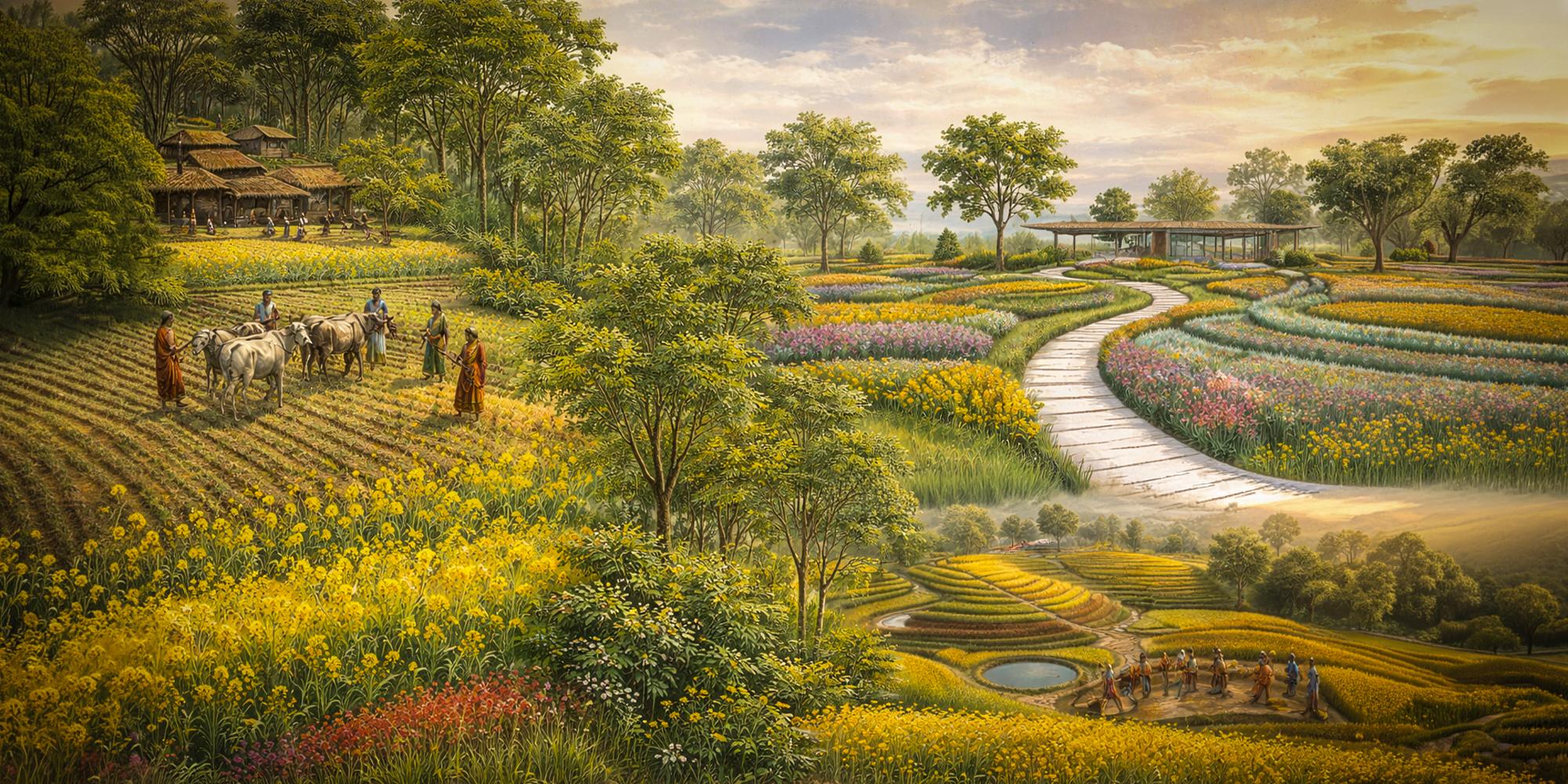
The Garden of Resilience is a living memorial that grows more beautiful with every passing year. The Garden features 1,947 trees — one for each year of the Partition — planted in careful arrangement across the campus grounds. Each tree is dedicated to a specific community, region, or family group affected by the Partition, and is identified by a small memorial plaque carrying the name and story of the dedicatee.
The trees have been selected from species historically associated with the cultural heartlands of Partition — the ancient pipal and banyan trees of Punjab, the palm and mango groves of Bengal, the neem and tamarind trees of Sindh. This deliberate selection ensures that the Garden is not merely an abstract memorial but a living evocation of the landscapes from which millions were expelled.
Individual trees may be dedicated in memory of specific individuals, families, or communities by making a donation to the Nyas’s Tree Dedication Programme. Each dedication is recorded in the Garden of Resilience Register and on the tree’s memorial plaque, and the dedicator receives a certificate of dedication and an annual photograph of the tree. The programme has been particularly popular among diaspora communities and the descendants of Partition survivors.
As the Garden matures, it creates a canopy of life and shade that transforms the campus into a living, growing testament to the resilience of those who survived. In spring, the flowering trees create a blaze of colour and fragrance that provides one of the most uplifting experiences the campus offers — a reminder that life and beauty can flourish even in the shadow of great grief.
Winding through the campus grounds, the Path of Remembrance is a beautifully designed heritage walkway punctuated by commemorative installations, sculptural works, engraved quotes from Partition literature, and interpretive panels that guide visitors through the history and legacy of the 1947 Partition. The Path is approximately 1.2 kilometres in length and takes approximately 45–60 minutes to walk at a contemplative pace.
Along the Path, visitors encounter:
The walkway is accessible to visitors with mobility impairments and is designed for both guided and self-guided visits. Audio guides narrated by survivors, historians, and cultural figures are available for download or at the campus information desk, transforming the walk into an immersive historical and emotional journey.
Acknowledging the profound emotional impact that engagement with Partition history can have on visitors — particularly those with personal family connections — the Nyas has created a dedicated Meditation Grove and Healing Garden at the eastern end of the campus. This tranquil, enclosed garden offers a quiet refuge for those who need to pause, breathe, and restore their emotional equilibrium.
Fragrant plants — including jasmine, rose, lavender, and mogra — create a sensory environment of peace and gentleness. Gentle water features provide soothing sound. Comfortable seating in shaded alcoves offers visitors a place to rest. The Grove is deliberately designed to feel separate from the rest of the campus — a space apart, where the weight of history is gently held, not denied, while the healing of the natural world is offered in support.
The Grove is also used for:
These grounds are for everyone — for those who come carrying names, for those who come seeking understanding, and for those who simply come to remember.

In 1947, the land of five rivers was divided. Millions were displaced. Centuries of shared culture, sacred shrines, and living heritage were torn apart overnight. Vibhajan Vibhishika Smriti Nyas is built so that nothing is forgotten.
Copyright © 2026 All Rights Reserved.